One hookload number does not tell you what the whole string is doing.
Torque, drag, tension, compression, and buckling screening are related views of one connected drillstring under specific movement, geometry, fluid, and loading assumptions.
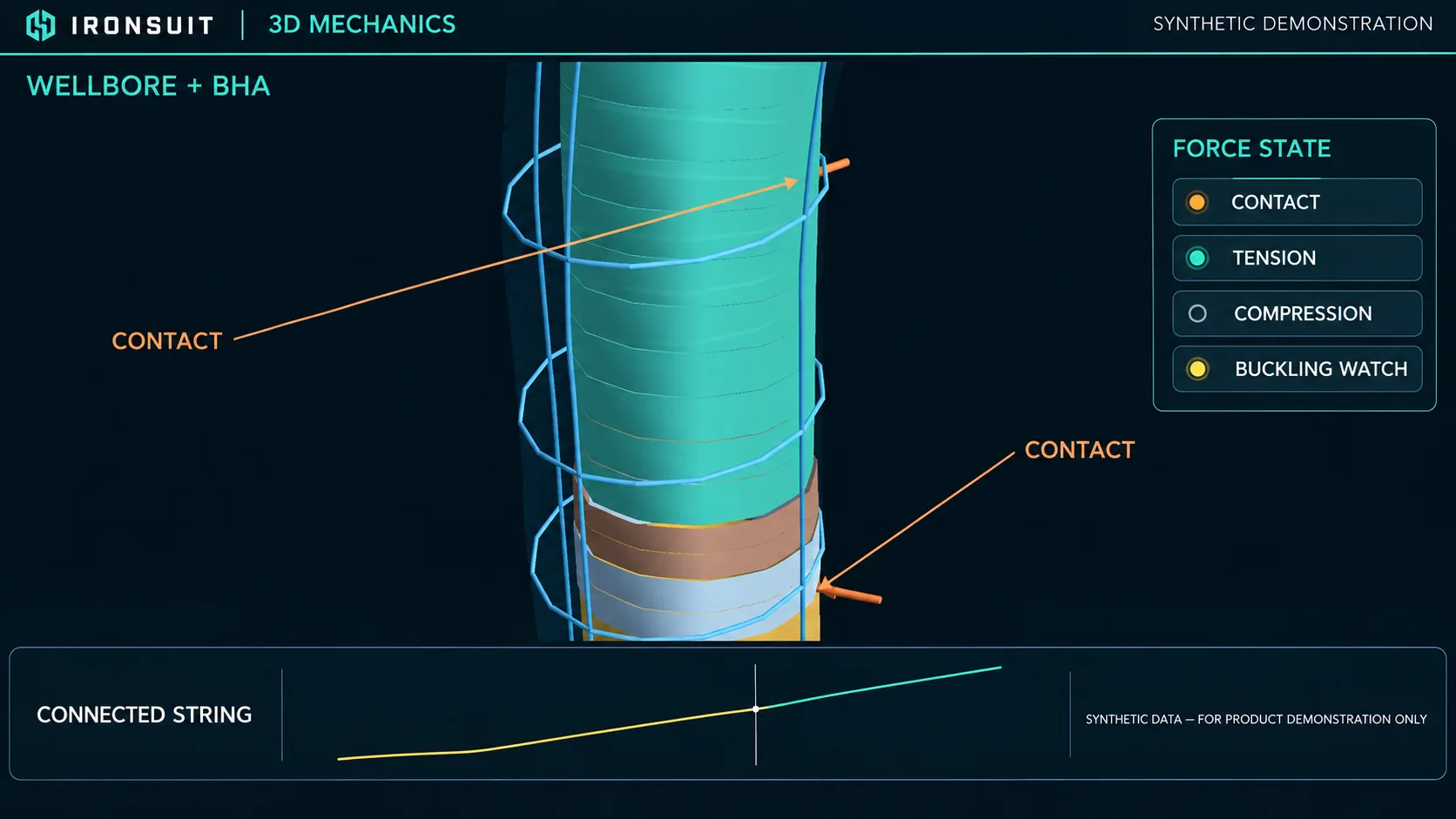
Torque, drag, tension, compression, contact, and buckling all belong to the same connected string. The well path, movement, fluid, BHA, pipe, and applied loads change what every section is doing.
I want to see that string section by section. I also want to know which inputs came from the active job, which ones were entered, and what is still missing.
Do not hand me one pretty number. Show me where the string changes.
The loads are connected because the string is connected
Torque describes rotational loading. Drag describes axial resistance while moving the string. Tension and compression describe axial-load distribution through connected sections. Buckling screening identifies where compression and support conditions require closer engineering review.
A change at surface can come from contact, wellbore geometry, fluid effects, the assembly, movement state, lithology, drilling parameters, or several of those at once. That is why a single surface value cannot describe the entire drillstring.
The model updates live. It is still a model.
The mechanics model updates from the active job. It is still a model—not a downhole sensor at every joint.
IronSuit keeps three things clear:
- Measurements: the surface and downhole data being used from the active job.
- Job setup: the connected string, well path, fluid, and current operating state.
- Calculated output: the result produced from the active inputs and configured string.
If those get mixed together, the picture can look more certain than the inputs deserve.
Missing inputs should stop the answer
People expect software to spit out an answer every time they click Calculate. Sometimes the right answer is HOLD—missing information.
If component geometry is missing, pipe is not represented, operating data is stale, or WOB, hookload, differential pressure, or motor data is not there, IronSuit flags it. I would rather hold the result than make up the input and hand somebody a confident-looking bad answer.
What a reviewer should be able to see
- Which parts of the string are included in the connected review.
- Whether the movement state matches the data being compared.
- Which inputs are measured, entered, estimated, or unavailable.
- Where screening changes from tension toward compression.
- Where buckling watch conditions appear and what limits the conclusion.
- Whether the calculation is ready to use or still missing what it needs.
Mechanics puts the string condition in front of the team. The rig driller still runs the rig, the DD still works the well, and the drilling engineer still owns the engineering call.
Why the connected view matters in the chair
The DD uses the mechanics view beside actual BHA response and trajectory tendencies. The drilling engineer reviews the torque-and-drag and buckling results before they become operating guidance.
That answer means more when it sits beside the current well path, assembly history, activity, and slide response. A number can be mathematically correct and still be the wrong number for the condition the crew is trying to understand.
The 3D view helps you see the mechanics
People understand geometry faster when they can see it. The 3D view shows the wellbore, assembly, contact direction, and force state together. It is a calculated view of the connected string, not a camera looking downhole.
The screen gives the drilling team a section-by-section mechanics view tied to the active job. The team still makes the operational call.
Sometimes the most useful result is a warning
The screen should tell you when a section is missing, an operating input is stale, or the calculation is not ready.
The point is simple: show the string condition, show the inputs, and flag what is missing.
A held result beats a polished answer built from missing data.
That is the point of IronSuit Mechanics: connect the string, show the load path, flag the missing inputs, and put the changing condition in front of the DD and engineer.